
IDENTITY CRISIS (1920’s)
When Eastern-European Jews began to flood into America during the early decades of the 20th Century, organized sports was as foreign to them as anything else they discovered here. For many of their offspring, however, baseball became their passion.
But baseball in this period was dominated by rural, uneducated Christian players who were hostile to Jews because of ingrained prejudice and/or due to the competition that the Jews represented for limited baseball jobs. In addition, in the aftermath of World War 1, as the Jewish population in this country swelled, so too did Antisemitism. The hateful Ku Klux Klan emerged, as did the Antisemitic forgery known as 'The Protocols of the Elders of Zion'. Worst still, there was alleged Jewish mob involvement in the World Series' Black Sox scandal of 1919.
As a result, Jewish baseball players in this era encountered vicious Antisemitism, with many changing their Jewish-sounding surnames and hiding their Jewish identities in order to play ball. For example, the first five (5) Cohens who played pro baseball instead became Kane, Cooney, Corey, Ewing and Bohne. It was not until 1926, with the arrival of Andy Cohen, that a Jew emerged who was willing to play baseball under an identifiably Jewish name.
Baseball Antisemitism persisted for decades thereafter, with Jewish players regularly identified in the press by their Jewish identity. However, name changes after Andy Cohen played ball became the exception.
This era also produced the first Clown Prince of Baseball, Al Schacht, and Catcher -Brainiac - American spy, the mysterious Moe Berg.
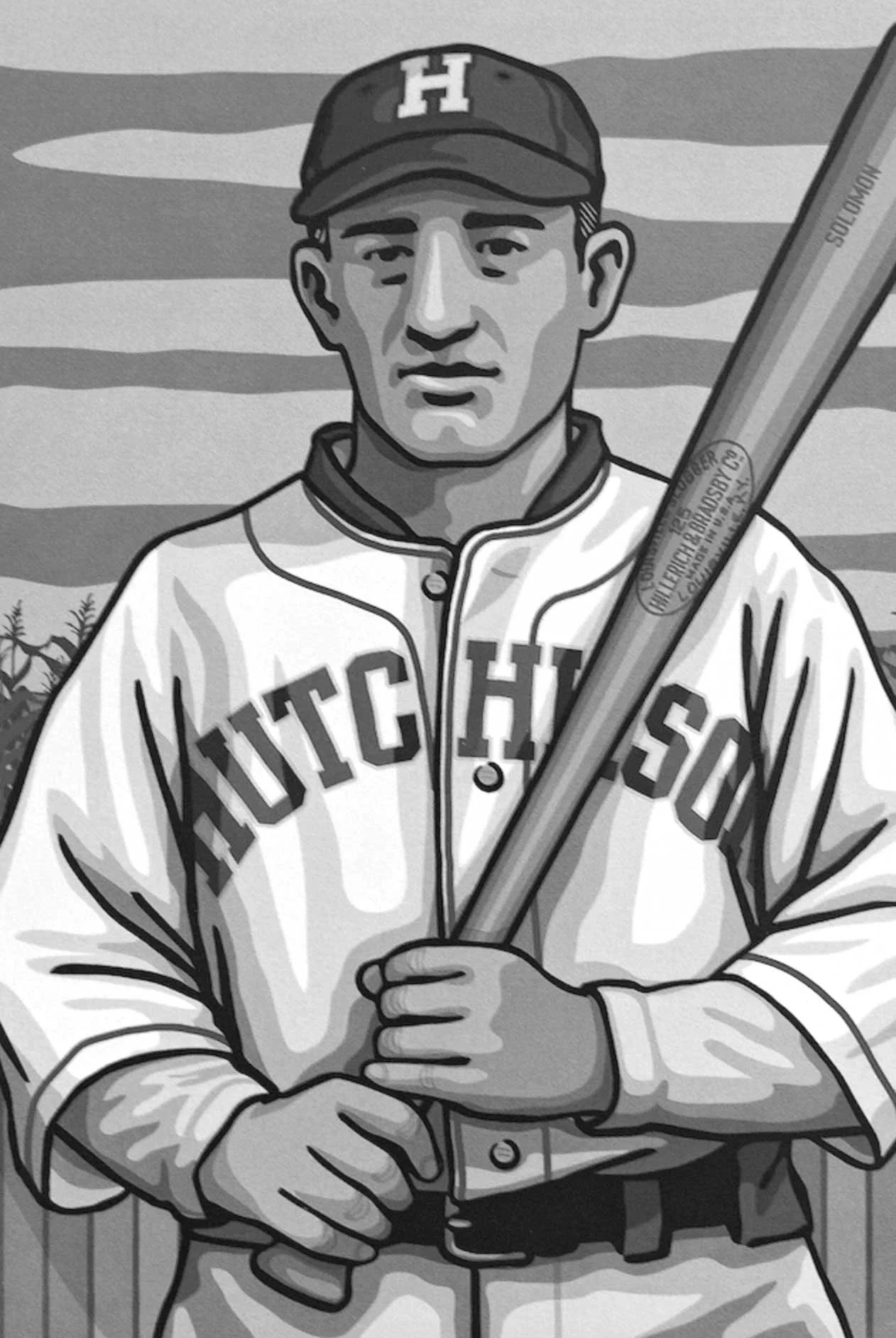
Paradoxically, although baseball Antisemitism flourished generally during the 1920's, in New York the situation was otherwise due to the city's greater than 25% Jewish population. For example, in pursuit of the first Jewish baseball superstar in order to attract more Jewish fans to the ballpark, NY Giants' future HOF manager John McGraw tried unsuccessfully for years to find one - auditioning not only Andy Cohen but others such as Mose Solomon, a homerun hitting phenom whose Major League career unfortunately flamed out soon after it began.
THE RABBI OF SWAT
MOSE SOLOMON (1900-1966)
digitally ILLUSTRATED BOOK PAGE FROM THE LEAGUE OF OUTSIDER BASEBALL, 12x12, test print (1/10)
GARY CIARADKOWSKI (2015)
Mose was a very large LH slugging centerfielder who was a proud Jew from Ohio. He was signed by the NY Giants in an attempt to increase the attendance of its Jewish fan base by wooing them away from the cross-town rival New York Yankees & Babe Ruth. In 1923, Mose hit more HRs - 49 - than anyone ever had except for Ruth. He had a very short-lived major league career however, because he refused Giants' manager John McGraw's demand that Mose remain with the team in the post-season without being paid, and despite the fact that he was ineligible to play. Mose also was a drop-kicker in the baseball off-season for a Native American football team - which included legendary athlete Jim Thorpe - with Mose barnstorming as a ringer under the alias Red Hawk.
comic book style drawing on paper, 16x20
JOSH NEUFELD (2024)
MAN OF MYSTERY
MORRIS ‘MOE’ BERG (1902-1972)
WATERCOLOR ON STRATHMORE ILLUSTRATION PAPER, 11x14
DREW FRIEDMAN (2024)
Moe was a skillful but often injured catcher from New Jersey who was known for being both The Brainiest Man in Baseball and The Strangest Man Ever to Play Baseball. After earning a degree in modern languages from Harvard - where he mastered seven languages - Moe also earned a law degree from Columbia. His eccentric brilliance (and hence the nickname The Professor) became known nationwide from his starring on a popular radio quiz show Information Please. Moe turned down a Princeton teaching position to sign with the Brooklyn Dodgers, the first of his five Major League teams. During WW2, Moe became an American spy and was sent on several highly dangerous missions; sadly, Moe later turned down the CIA's Medal of Merit because he couldn't talk about how he had earned it. Moe's amusing last words were "How are the Mets doing today?" His ashes were scattered over Hebrew University in Jerusalem.
GRAPHITE ON archival PAPER, 8x11
MARGARET LAWRENCE (2024)
digitally illustrated book page FROM THE LEAGUE OF OUTSIDER BASEBALL, 12x12, test print (6/10)
GARY CIARADKOWSKI (2015)
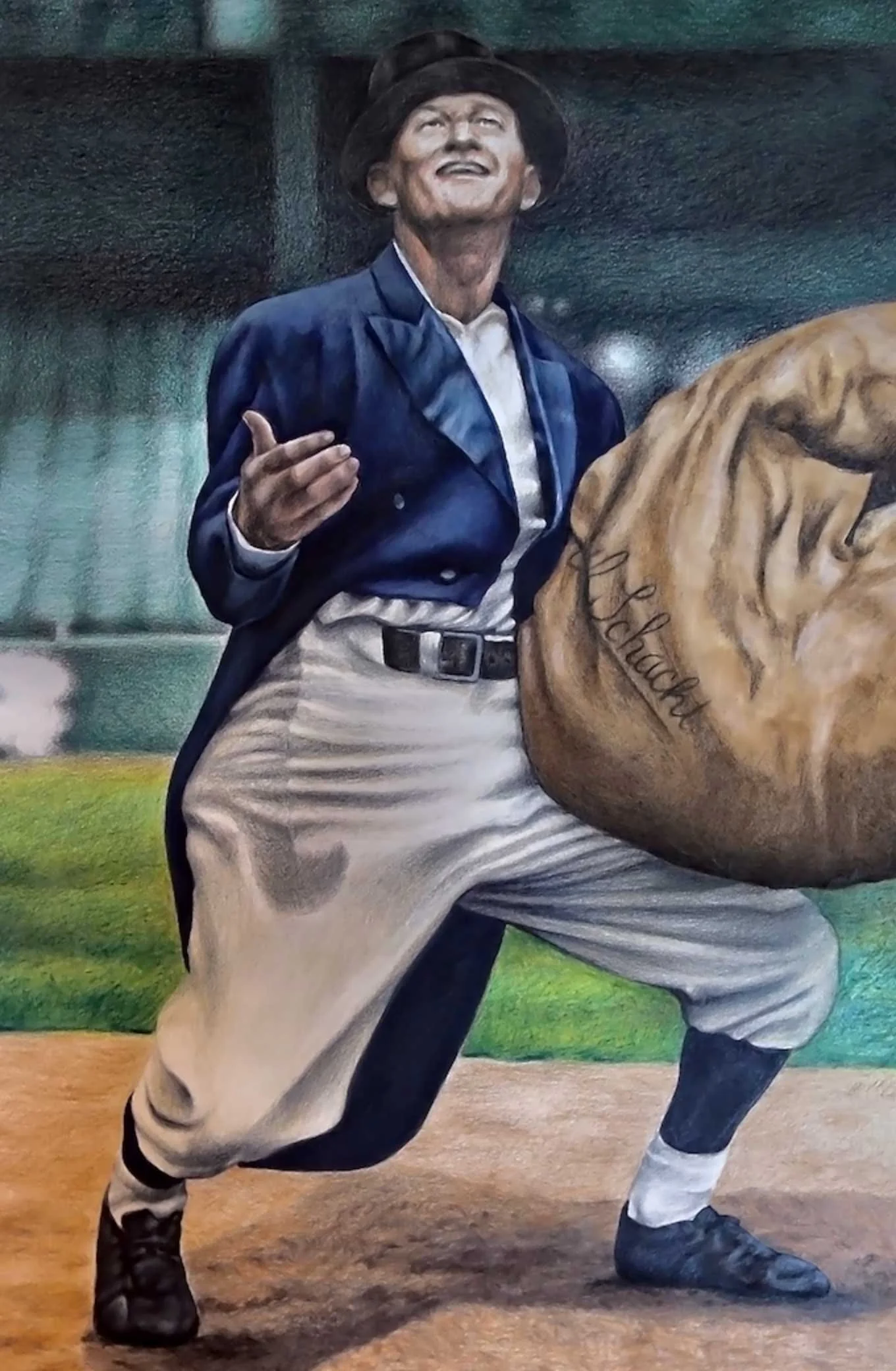
THE CLOWN PRINCE
AL SCHACHT (1892-1984)
COLOR PENCIL ON PLATE SURFACE BRISTOL, 19x21
ROBERT MCFETRIDGE (2024)
Al was the first comedian to gain fame by entertaining baseball fans at the baseball park. During his decades-long career, over 68 million people saw Al perform as The Clown Prince of Baseball, more than had seen any other entertainer in history. Born on the site that later became Yankee Stadium, his orthodox Jewish mother tried to turn him into a rabbi as was his grandfather. Al first pitched briefly for the Washington Senators, with a fadeaway pitch (screwball) he learned from legendary pitcher Christy Matthewson when Al was a NY Giants’ errand boy. He always described himself as homely, and a Native American roommate said that Al's nose was so big that he looked like 'a Jewish Indian. During WW2, before comedian Bob Hope began his famed USO tours, Al entertained American troops in many dangerous war zones, later writing about those exploits in one of his books, G.I. Had Fun. In retirement, Al owned a famed eponymous Park Ave. restaurant in NYC, a haunt for athletes & other celebrities.
CARTOON IN THE SPORTING NEWS, 9x9
UNCREDITED ARTISt (1939)
[Not Original]
THE ICE CREAM COHEN
ANDY COHEN (1904-1988)
Oil on LINEN Canvas, 16x20
Graig Kreindler (2024)
Known as The Great Jewish Hope, Andy was so popular in NY while playing 2B for the New York Giants that he even had an ice cream named after him. He also performed a Vaudeville act in the off-season and had a comedy movie Hot Curves written about him. Andy was a Texas Jew and the first Cohen to refuse to change his Jewish-sounding name, unlike many Cohens before him, in order to play pro baseball. Although he had a short playing career, Andy then spent decades in baseball as a coach and manager, resulting in the minor league ballpark in El Paso, TX, being named after him and his fellow major leaguer brother, Syd. In Andy's only managerial stint (with the Philadelphia Phillies), he compiled a perfect winning record, 1-0! At the U. of Alabama, Andy also was a football running back nicknamed The Tuscaloosa Terror, and captained the baseball team - the first Jew ever to captain any sports team in that Deep South school.
cartooN IN DENVER BEARS SKETCH BOOK, 5x8
BOB BOWIE (1951)
[Not Original]
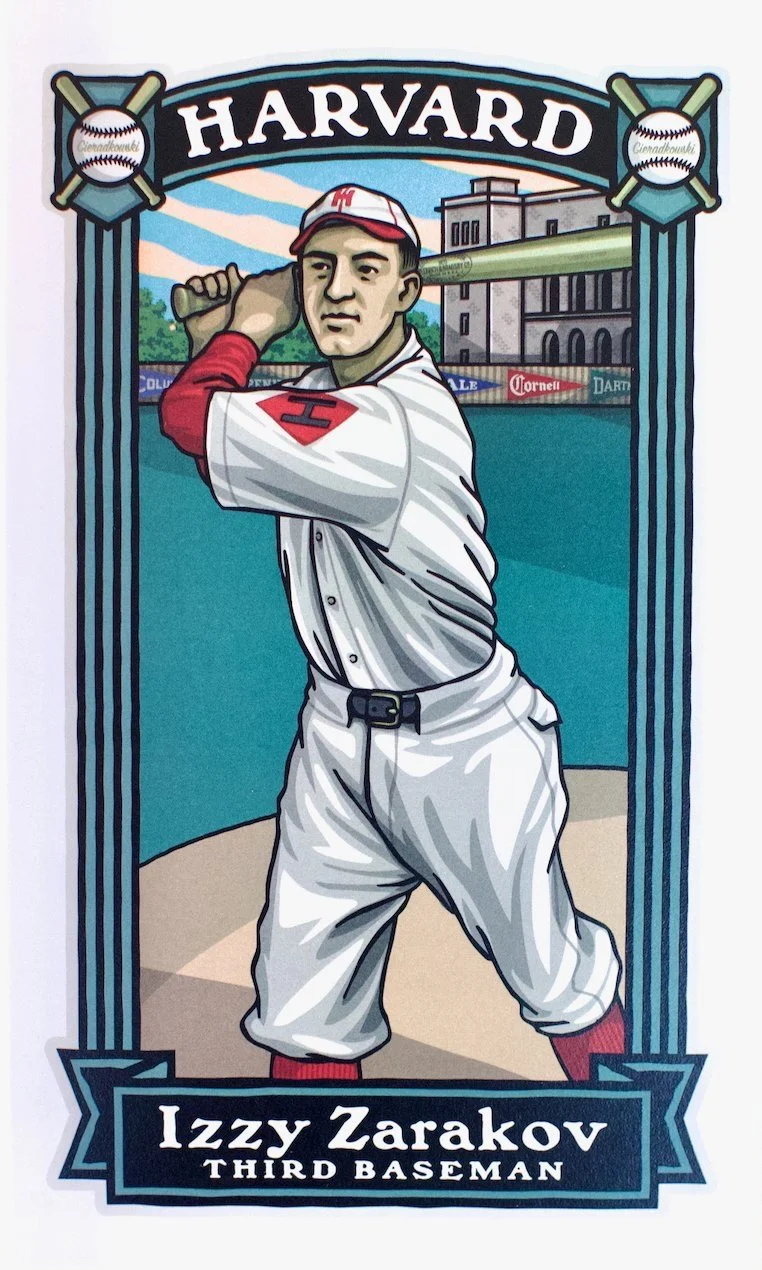
Lovingly called The Yiddish Babe Ruth, Izzy was so busy at Harvard with sports and his upcoming marriage that he failed to take his senior year general exam and thus never graduated. That didn't stop Harvard, however, from later inducting him into its varsity hall of fame. Izzy's 1927 Harvard baseball team is considered one of the best all-time college baseball teams. In an era when Harvard had imposed severe discriminatory Jewish quotas, Izzy proudly belonged to the predominantly Jewish college fraternity Zeta Beta Tau. Even in high school Izzy had been such a baseball prodigy that he played all nine positions while captaining a team which amazingly included two future Major Leaguers. Izzy later owned and ran Camp Zakelo, on Maine's Long Lake. The camp was an unusually heady environment as it featured not only athletics but also an orchestra, a newspaper, theatre, astronomy and foreign language study.
A HARVARD MAN
IZZY ZARAKOV (1904-1988)
MR. UNQUESTIONABLE
ALBERT ‘DOLLY’ STARK (1897-1968)
SPRAY PAINT & STENCILS ON CANVAS, 30x30
MATT SZCZUR (2024)
Dolly was a poor kid from the Lower East Side of Manhattan, who was a childhood friend of fellow Jew and legendary baseball comic Al Schacht. Dolly overcame being raised in a shelter for homeless children to eventually become the first Jewish umpire in the Majors. While a minor league 2B, he was given his nickname Dolly due to there being a Stark at the time with the same nickname who played baseball for The Brooklyn Superbas - one of the Dodgers' earlier names. A very popular NL umpire, Dolly was known for being the first to actually move around the field to be in the best position to make a call. In 1934 and 1935, he was voted the NL's Most Competent Umpire. Dolly is the only umpire in Major League history to be given a 'Day' in his honor; the NY Giants so honored him at the Polo Grounds. In his varied career, Dolly coached basketball as well as baseball at Dartmouth U., was part of the first Philadelphia Phillies radio announcing crew, and became a successful women's clothing designer...creating a popular post WW2 sundress pattern known as The Dolly Stark Dress.
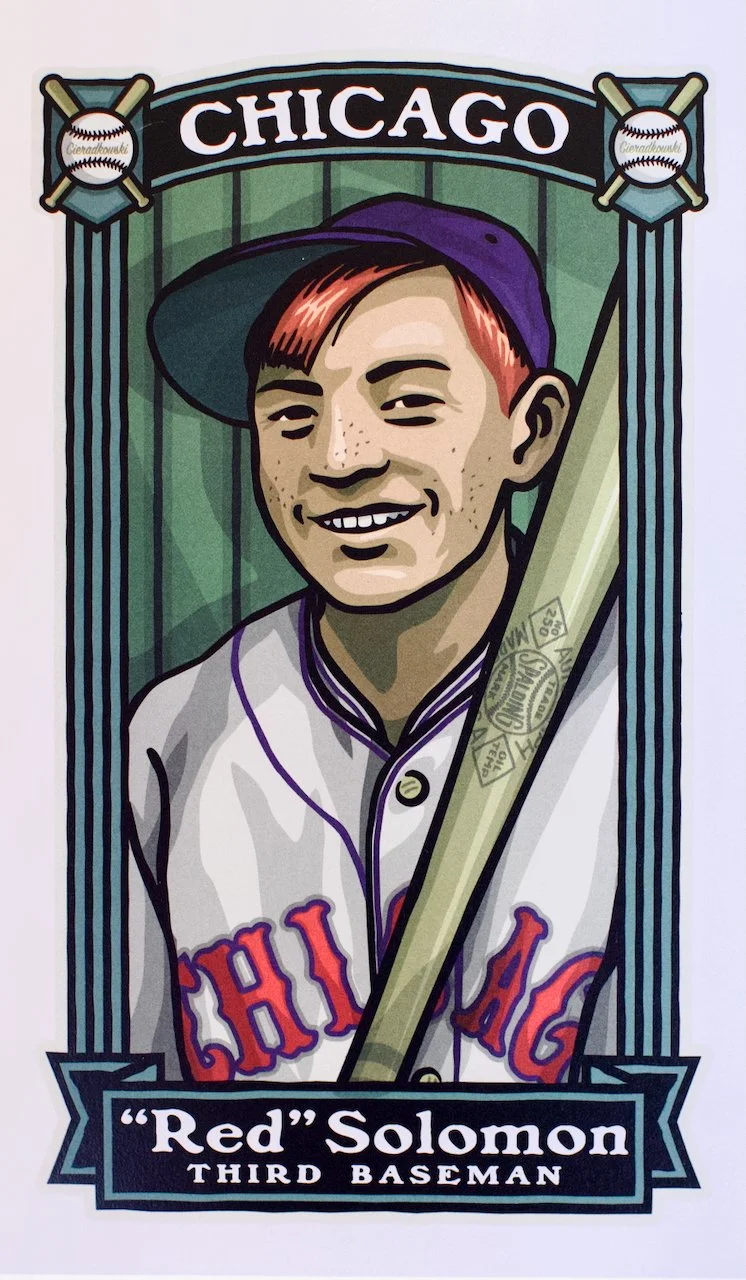
THE YOUNGSTER
SAMUEL ‘RED’ SOLOMON (1916-1991)
When 75 lbs. Sam Solomon (nicknamed "Red" for his flaming red hair) was signed to a Major League contract by the Chicago Cubs as a 13 year old, he was the youngest player ever to be signed...by a lot; the next youngest - at age 15 - was Waite 'Schoolboy' Hoyt, the future Hall of Famer NY Yankees pitcher. Even earlier, at age 12, Red not only had starred on his national championship sandlot team, but also had served as its manager. His famed Cubs manager, Joe McCarthy, called Red the Jewish boy with the Irish face and "the best natural baseball player for his size I have ever seen." Red called himself the luckiest boy in the whole world, and the Cubs paired him with a baseball etiquette teacher to teach him such lessons as 'bathe after every baseball game' and 'don't wash your food down with water'. Though Red's signing by the Cubs was a publicity stunt conceived by Cubs President Bill Veeck, Sr., and lasted only for the 1929 season, his fame continued to be such that when he was seriously injured playing baseball years later, a benefit was held for him at the Polo Grounds to help pay his hospital bills, and many baseball stars - including fellow Jew & Bronx native Hank Greenberg - came to visit him in the hospital.
PHILLY'S FINEST
THE SPHAS
(with Dr. Pete Leaness) (1920's-1940's)
OIL ON CANVAS, 16x20;
RILEY WAITE (2025)
The SPHAS were an American semi-pro baseball team from South Philadelphia that barnstormed in the early part of the 20th century. The team's name is an acronym derived from South Philadelphia Hebrew Association (one of the groups that funded the team), and the team's players were Jewish. Not much is known about the baseball SPHAS other than that they were connected to the famous SPHAS basketball team which became a regionally dominant and ultimately professional powerhouse from the late 1920's to the early 1940's. The baseball SPHAs (like their basketball relatives) were founded and operated by South Philly Jewish friends who were stars in both baseball & basketball. Those young men, Eddie Gottlieb, Chick Passon and Hughie Black, soon formed PGB Sporting Goods in Philadelphia, in part to be able to get better uniforms for their teams than their sponsoring organizations would provide. PGB later became Passon's Sporting Goods, downtown Philadelphia's leading sporting goods store during the first half of the 20th century. Moreover, Passon & Gottlieb were responsible for making Philadelphia a leading center for semi-professional sports, especially baseball, during that time period. Passon himself designed the SPHAS uniforms, with the most common iterations featuring either the Hebrew letters ספהא, which spell out the acronym SPHA in the Hebrew alphabet, or the word 'Hebrews' written in English with a Star of David beneath. The player picured in this artwork was one of the best known of the SPHAs baseball players, Dr. William "Pete" Leaness, who went on to be regarded as the Dean of American soccer collegiate coaches, coaching Temple University's team for over 40 years. To pursue soccer and his chiropractic career, Leaness gave up an opportunity to play professional baseball despite being a star 3B for Temple U. and being selected to the first ever college All-American baseball team.
Collections By Era
-
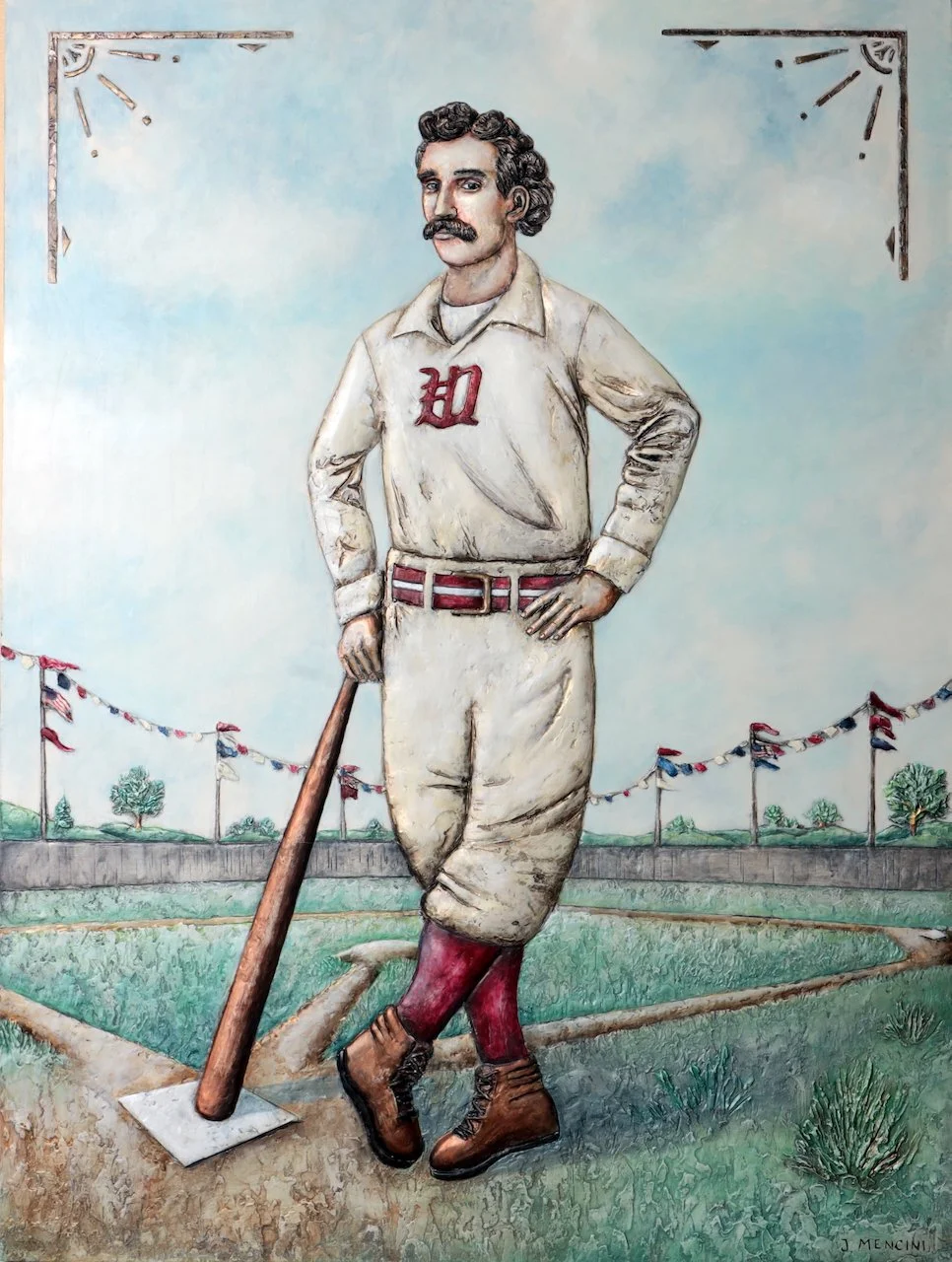
BECOMING AMERICAN
(1870’s-1910’s)
-
IDENTITY CRISIS
(1920's)
-
EMERGENCE
(1930’s - WORLD WAR II)
-
LIFE AFTER HANK
(POST WW II - 1950’s)
-
ACCEPTANCE
(1960’s-1970’s)
-
THE VANISHING
(1980’s)
-
THE RETURN
(1990’s - 2000’s)
-
A BRIGHT FUTURE
(2010’s - Present)