
BECOMING AMERICAN(1870’s-1910’s)
In 1871, a 26-year-old New York City Jew of Dutch origin named Lipman Pike became the first Jew to play professional baseball.
To Jews of Lipman's era, becoming involved with baseball was to enter the American mainstream, to 'make it' in America by absorbing, as well as contributing, to the country's sporting life.
Baseball appealed to Jews of that era also because it was a game which cherished history and statistics. For Jewish people, the game's intricacies & personalities allowed a new world way to study and debate, much as they had in their old-world religious centers of learning.
Baseball had been officially established in the 1840's, but its rapid development post-Civil War as a unique American sport paralleled the rapid growth of the Jewish-American community itself.
Until the Civil War, American Antisemitism had been relatively dormant. However, due to their supposed 'foreign' habits & post-war involvement as financial middlemen, Jews in this country increasingly began to be targeted for attack after the war.
In response, they sought ways to assimilate. Since American Jews could not yet easily participate in American civic life for a number of reasons, many instead chose involvement with baseball, either through employment or merely fandom, as a way to show that they truly were Americans.
It was not easy for Jews, struggling to eke out a living and primarily located in urban ghettos lacking space for sports, to play a game such as baseball. Consequently, there were very few Jewish pro baseball players in the game's pioneering 'Deadball' era.
While Lipman Pike was the primary Jewish star of his era, the Yiddish Curver Barney Pelty also was noteworthy. In addition, the early years of baseball began the life-long involvement of such iconic figures as Barney Dreyfuss, Father of the World Series.
THE IRON BATTER
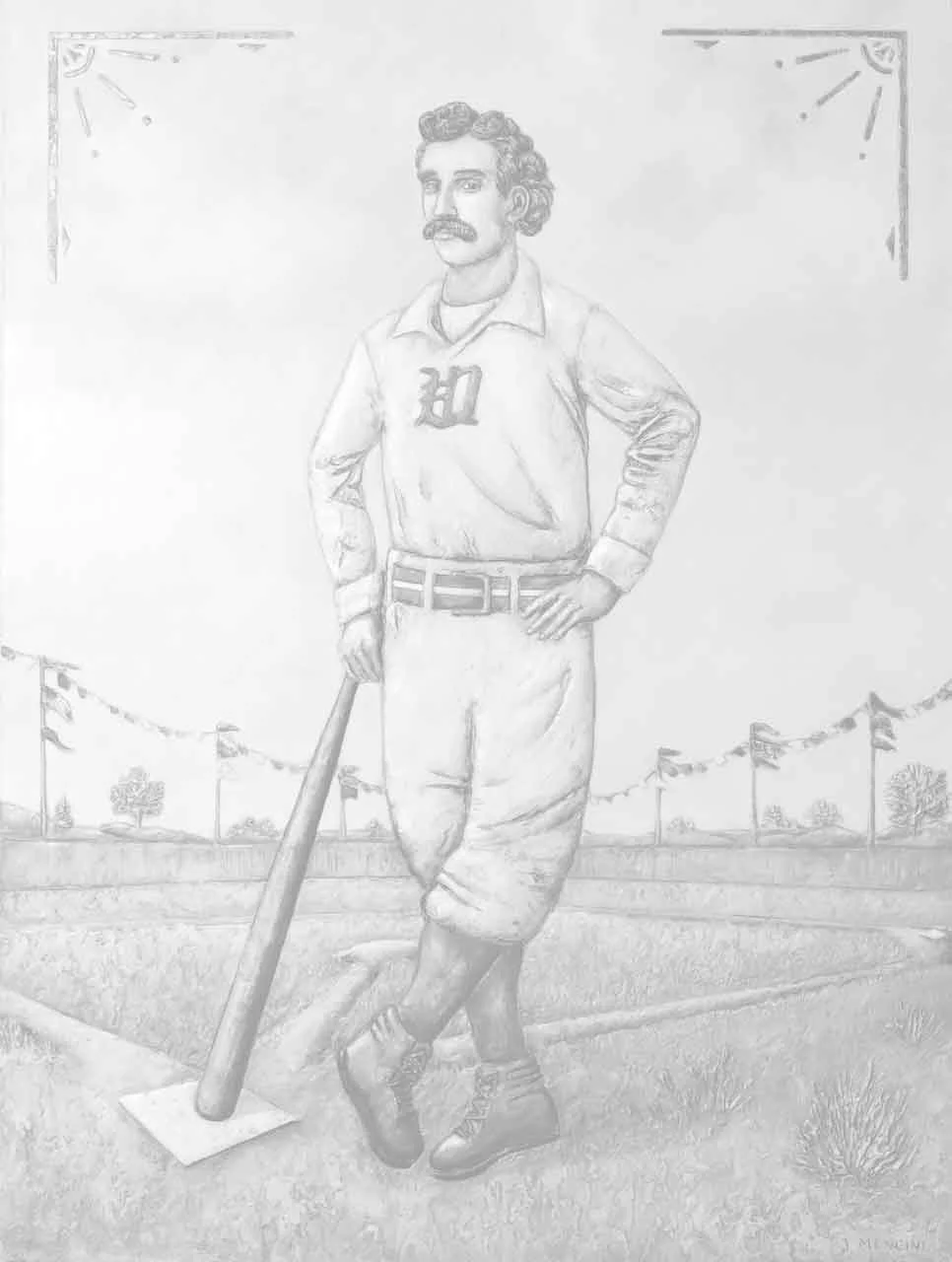
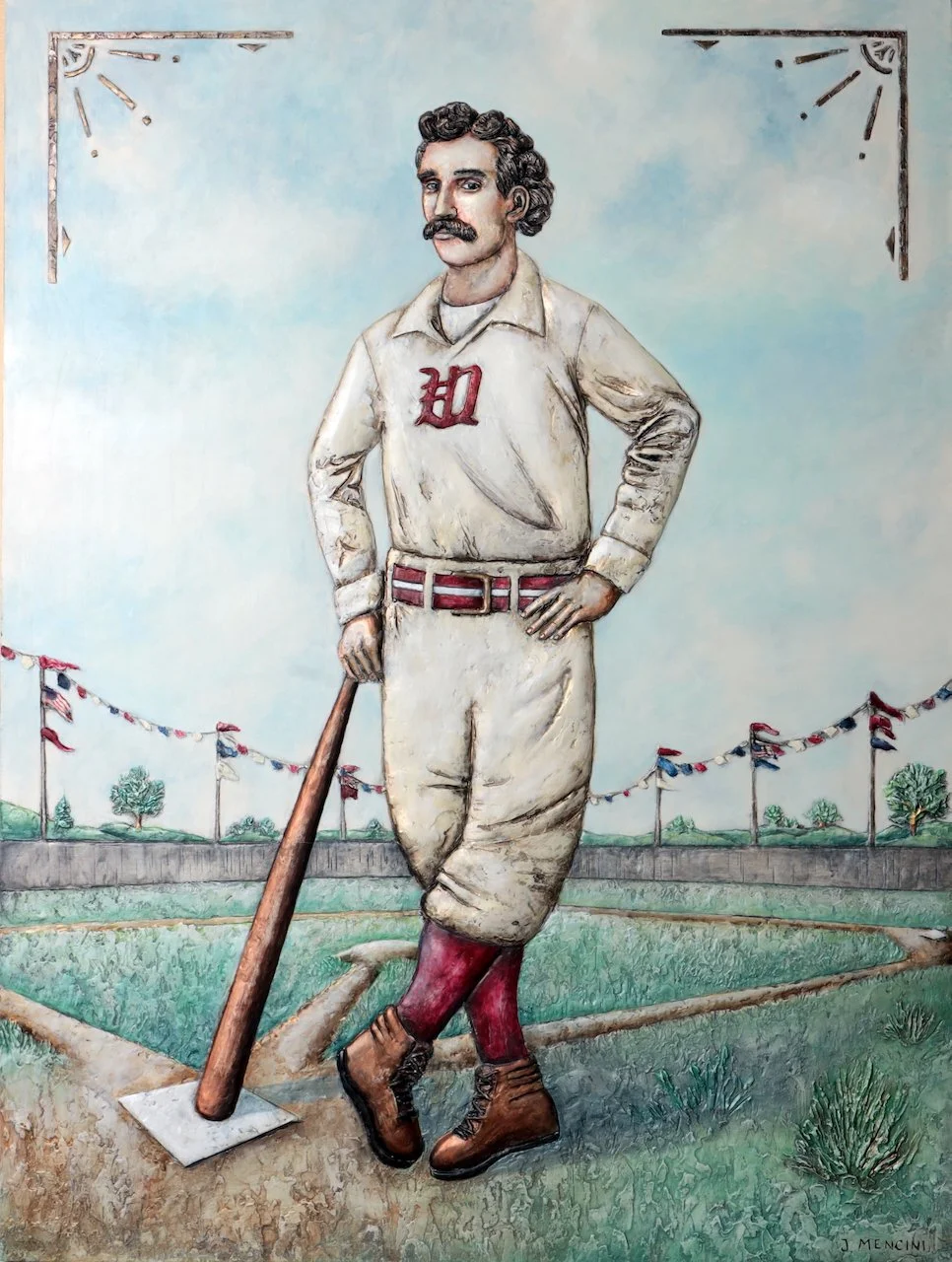
LIPMAN PIKE (1845-1893)
BAS-RELIEF: PLASTER, ACRYLIC & METALLIC PAINTS ON CANVAS, 36x49
JUSTIN MENCINI (2024)
Known as The Iron Batter for his hitting prowess, Lipman was the pioneer of Jewish involvement in professional baseball. A NYC boy from a Dutch-Jewish family, he established numerous on-and-off the field baseball firsts. In 1871, playing for the Troy Haymakers, he became the first Jewish professional ballplayer, as well as perhaps the first paid ballplayer in the history of baseball. This handsome, slugging centerfielder also was the first Jewish manager & the first season HR leader, although he hit only 4 HRs, in what was the Deadball era. On a bet, Lipman's dazzling speed helped him beat Clarence The Trotting Horse in a 100-yard dash.
PIKE & the atlantics of Brooklyn
ENGRAVING in Harper’s weekly Magazine, 11x16
UNCREDITED ARTIST (1866)
[Not Original]
THE VISIONARY
BARNEY DREYFUSS (1865-1932)
titled mr. dreyfuss
AcRYLIC ON CANVAS, 16x20
LARRY KLUKASZEWSKI (2024)
Called The Father of the World Series for his pivotal role in its creation, Barney nevertheless could not attend the first ever World Series game because it happened to fall on Yom Kippur. As the owner of the Pittsburgh Pirates for over thirty years, this German-born businessman with an unsullied reputation won the World Series twice, and built Forbes Field, the first concrete and steel stadium in the National League. Barney took up baseball initially for exercise in order to recover from poor health brought on by overwork in his relatives' Kentucky bourbon business.
THE YIDDISH CURVER
BARNEY PELTY (1880-1939)
OIL ON CANVAS, 14x32
GARY DAVIS (2024)
Barney was a RH pitcher for the St. Louis Browns and one of the best American League pitchers of his era. This Missourian was among the first to proudly bear a nickname, The Yiddish Curver, based upon his Jewish identity. Barney's exceptional curveball was his calling card, and he still boasts the lowest career ERA of any Jewish pitcher, better even than Sandy Koufax. He pitched 175 complete games in only 217 career starts, an unheard-of statistic in today's game.
THE LADY GIANT
IDA SCHNALL (1889-1973)
OIL ON CANVAS, 18x24
JESSICA BRACKETT (2024)
Ida was a lifelong promoter of equal rights for women athletes long before Billie Jean King. She was the Austrian-born creator of and a star pitcher for The NY Female Giants, an early 20th century NY women's barnstorming baseball team composed of both Jewish & Gentile women. Ida was the greatest female athlete of her time because of the multiple sports at which she excelled (baseball, swimming, diving, tennis, etc.) She also was named America'sMost Beautifully Formed Woman, and later became a noted Hollywood actress. Despite her great celebrity (and having been invited to The White House by President Taft), Ida - a swimmer & diver - and all other American female athletes, were denied participation on the U.S. team at the 1912 Summer Olympics in Stockholm although other countries allowed their women athletes to participate.
MR. CLEAN
ERSKINE MAYER (1889-1957)
BIO-ILLUSTRATION DRAWINGS (2) FRAMED WITH A COPY CONTAINING DIGITALLY ADDED TEXT used in the final version FOR SPORTS COLLECTORS DIGEST, 4x8 LARGER drawing, 3x3 smaller drawing, 6x9 scd
RONNIE JOYNER (2001)
Erskine was a RH pitcher from Georgia who spent most of his career with the Philadelphia Phillies. He was not approached by his Chicago 'Black' Sox teammates to get involved in their conspiracy to fix the 1919 World Series because they didn't trust him or any Jew. Nicknamed Eelskine because of his 'slippery' sidearm curveball, Erskine once threw 16 consecutive scoreless innings in a game. He also played college football at Georgia Tech under the legendary coach John Heisman. (See cartoon text itself for additional info.)
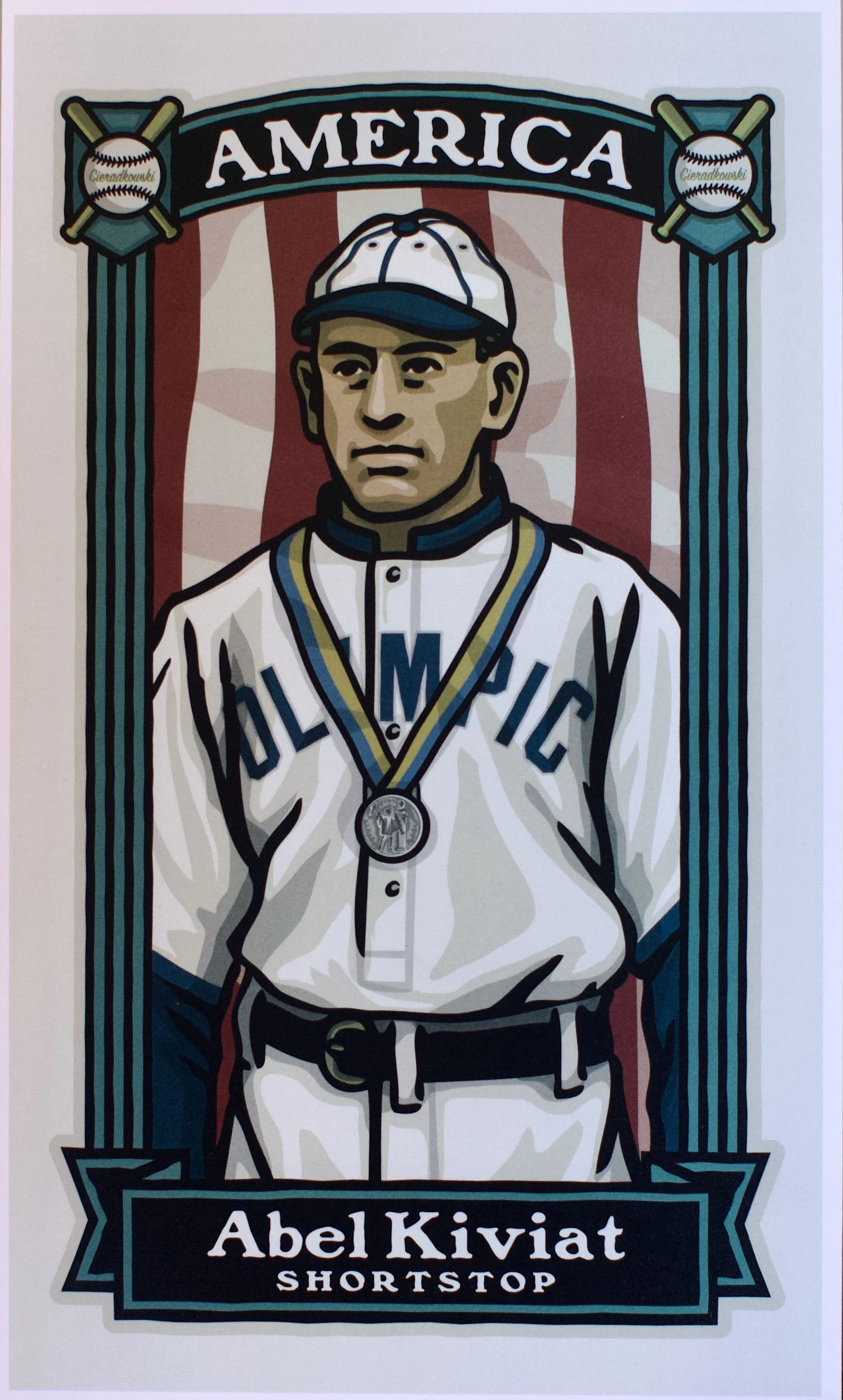
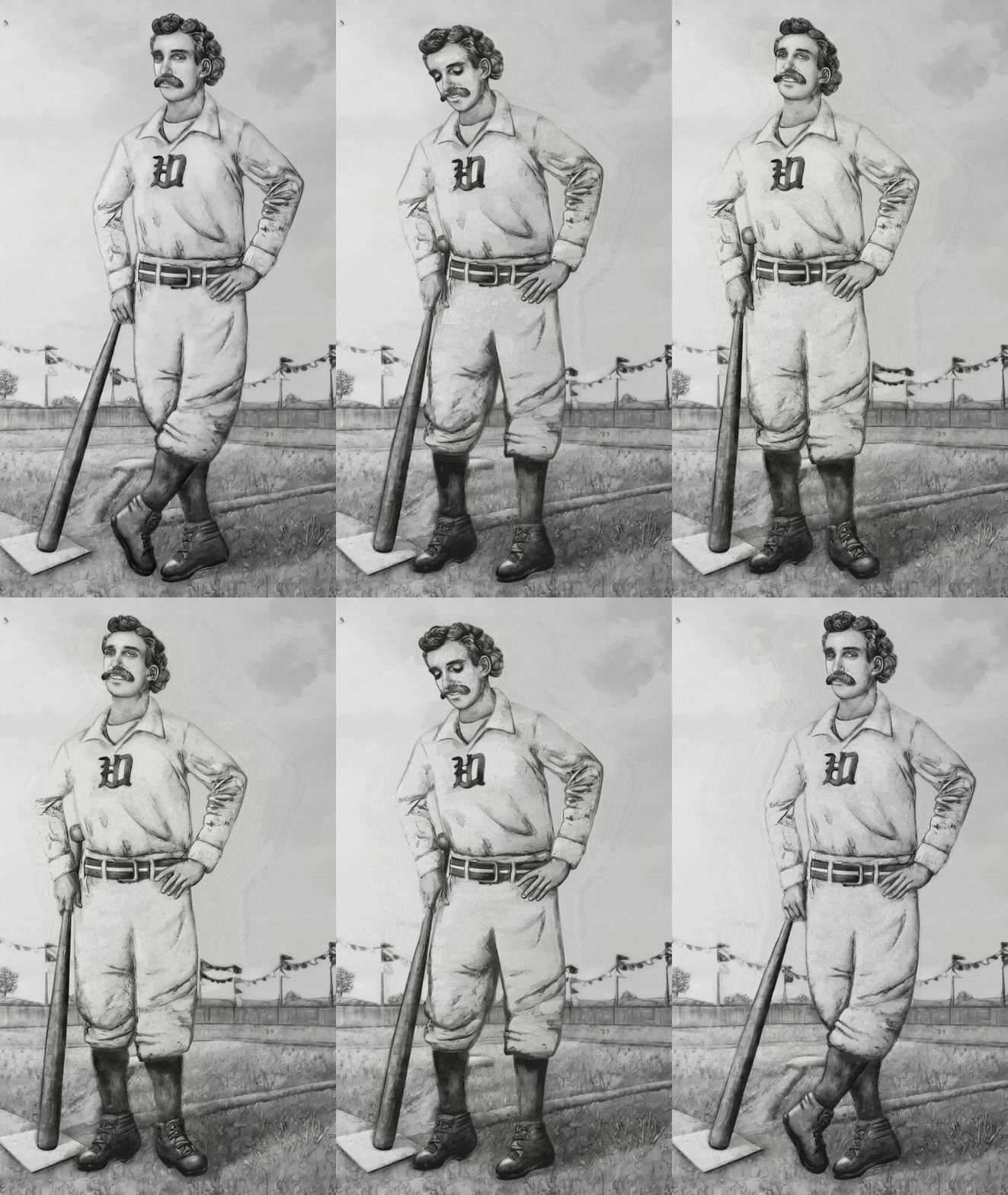
THE OLYMPIAN
ABEL KIVIAT (1892-1991)
SKETCHES (2) & ENLARGED VERSION OF DIGITALLY CREATED BASEBALL CARD (front & back separated) FOR THE INFINITE BASEBALL CARD SET, 6x9 (card), 8x11 (final sketch), 5x8 (initial sketch with notes)
GARY CIARADKOWSKI (2019)
Abel helped introduce baseball to an international audience in 1912 by starring in an American victory over host Sweden in the first baseball game ever played in The Olympics (where it was played as a ‘demonstration’ sport). Despite being bow-legged, he also became an Olympic gold medalist and world record middle distance runner. Abel was chosen team captain of NY's acclaimed Irish-American Athlete Club despite his Jewish ethnicity. During WW1, Abel served with valor on the front lines in France.
JOSHUA SUBDUES THE HITTITES
CARTOON IN LIFE MAGAZINE, 11X18
ROBERT JOHN WILDHACK (1915)
[Not Original]
The Hebrew Bible opens with the words "In the Beginning…." Jewish baseball fans would like to believe that what really was meant to be written was "In the Big Inning…." During the time of Lipman Pike and his Jewish baseball 'Beginning', Jews involved in America's Game were routinely identified as members of the Hebrew race, and Jewish involvement in sports, real or imagined, routinely became the subject of humorous sports cartoons as in this example.
ANTISEMITIC BASEBALL POSTCARD
on card stock, 3x5
UNCREDITED ARTIST (1915)
[Not Original]
As negative feelings towards Jews in America increased in the early 20th Century, so did insulting commentary about them as a people. Jews had come to be viewed as non-athletic, having a distinctive unattractive appearance, and being unscrupulous pawn brokers. The 'Three Balls’ reference concerns the store signs which traditionally hung outside pawnbroker shops, which in those days were often operated by Jews. When such negative ideas became the fodder for cartoonists, vile stereotypes such as depicted on this postcard became increasingly routine.
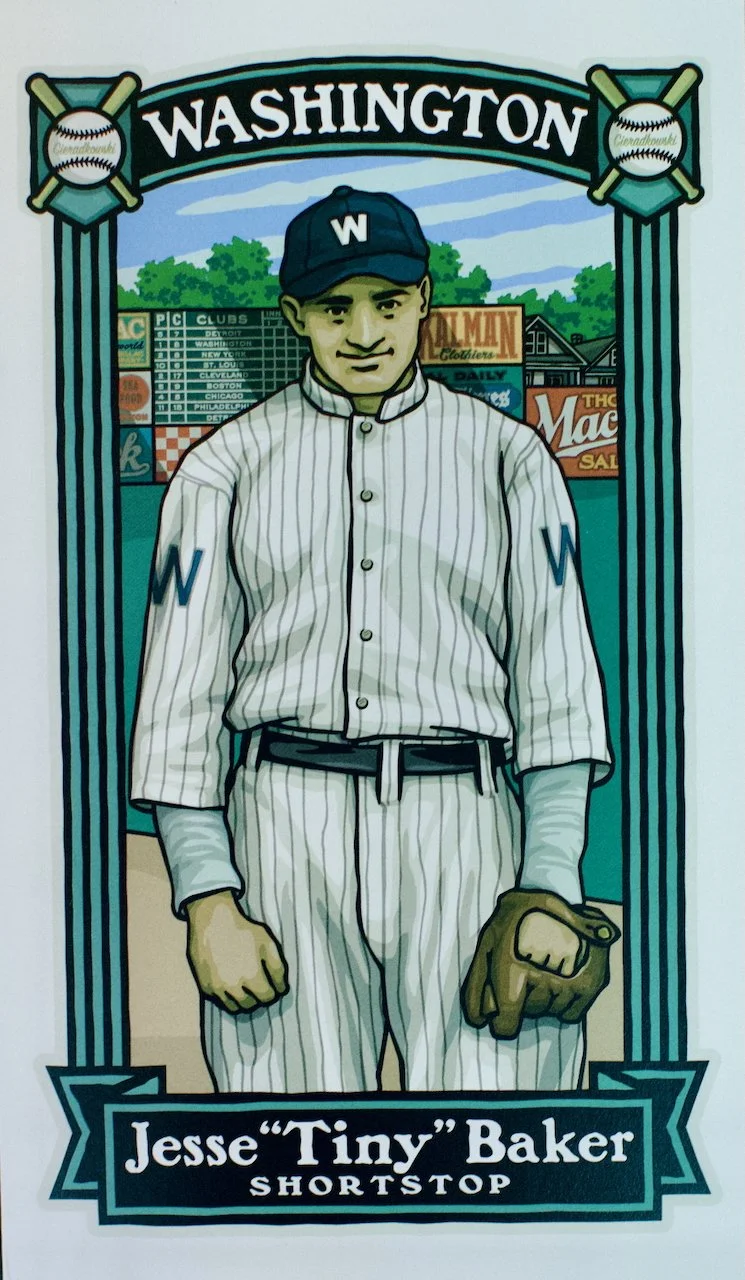
TINY
JESSE BAKER (1895-1976)
At 5'4" tall, Tiny Jesse Baker was a shortstop from Cleveland [born Michael Meyer Silverman] and the smallest man in baseball. He had a long pro career but - like many Jewish ballplayers - spent very little time in the Major Leagues, i.e., he only had the proverbial Cup of Coffee. Spiked by Ty Cobb, Jesse had to leave the only Major League game in which he ever played (for The Washington Senators) before even getting an At Bat. He later became a boxing promoter and a larger-than-life figure at prizefights & racetracks, palling around with Jewish notables such as The Marx Brothers and legendary columnist Walter Winchell.
SKETCHES (2) & ENLARGED VERSION OF DIGITALLY CREATED BASEBALL CARD (front & back separateD) FOR THE INFINITE BASEBALL CARD SET, 6x9 (card), 8x11 (final sketch), 5x8 (initial sketch with notes)
GARY CIARADKOWSKI (2019)
THE PIANO MAN
ALBERT VON TILZER (1878-1956)
'1/1' DIGITAL CARTOON, 16x20
SAM VILLAREALE (2025)
Albert was a songwriter from Indiana who wrote the music to many hit songs from the early 1900's to the 1950's, including those to baseball's beloved national anthem, Take Me Out to the Ballgame. That song, composed in 1908, is now sung during the seventh inning stretch in ballparks everywhere. Prior to writing that music, Albert had never attended a baseball game (nor had his partner Jack Norworth, who wrote the lyrics.) The song initially gained popularity as a result of being featured in movie theatres during intermission, with lyrics on the screen and the audience encouraged to sing along to the chorus. A 1949 movie of the same name, starring Frank Sinatra, Gene Kelly & Esther Williams, cemented the song's place in American folklore. Even before that, in 1940 the Brooklyn Dodgers held a special day for Albert at Ebbets Field. Albert came from a family of songwriters, the most famous of whom was his older brother Harry...after whom the term Tin Pan Alley was coined. Although the original family name was Gumm (shortened from Gumbinsky), older brother Harry took his Mother's maiden name, Tilzer, and added the Von to make it sound like German nobility. After achieving superstar status as a pop music writer (having over 20 songs which sold over 1 million copies), Albert wrote full Broadway scores and later moved to Hollywood to write songs for motion pictures.
Collections By Era
-
BECOMING AMERICAN
(1870’s-1910’s)
-
IDENTITY CRISIS
(1920's)
-
EMERGENCE
(1930’s - WORLD WAR II)
-
LIFE AFTER HANK
(POST WW II - 1950’s)
-
ACCEPTANCE
(1960’s-1970’s)
-
THE VANISHING
(1980’s)
-
THE RETURN
(1990’s - 2000’s)
-
A BRIGHT FUTURE
(2010’s - Present)